
What Age Should Your Child Start Music Lessons?
A Practical Guide for New Hudson Families
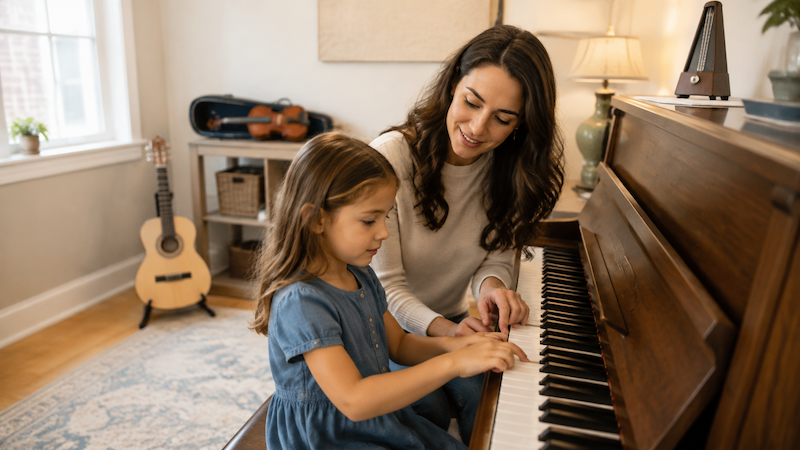
Parents often wonder whether their child is old enough to begin music lessons—or whether they may already have waited too long.
There is no single perfect age for every student. A child’s readiness depends on the instrument, attention span, physical development, and genuine interest in learning. Many children are ready for private music lessons around age five, but some benefit from waiting a little longer. Others may be prepared to start sooner with the right lesson format and teacher.
The goal is not simply to begin as early as possible. It is to start when lessons can become a positive and productive part of the child’s life.
Why Age Five Is a Common Starting Point
Around age five, many children can focus on one activity for a short period, follow basic instructions, and begin practicing simple skills between lessons. They are also developing the coordination needed to play an instrument.
Piano is particularly well suited to this age. Students can see how the notes are arranged, produce a clear sound without needing advanced hand strength, and begin learning melody and rhythm in manageable steps.
Lessons for young beginners should remain encouraging and age appropriate. A five-year-old will not approach music in the same way as a teenager or adult. Short activities, repetition, familiar songs, and achievable goals help younger students build skills without becoming overwhelmed.
Signs Your Child May Be Ready
Age provides a useful guideline, but readiness is often more important. Your child may be ready for lessons if they:
- Regularly show interest in music or a particular instrument
- Can focus on an activity for approximately 15 to 30 minutes
- Follow simple directions from an adult
- Enjoy learning new skills
- Can handle gentle correction without becoming excessively frustrated
- Are willing to practice briefly at home
- Ask about taking lessons or frequently pretend to perform
A child does not need to demonstrate every one of these signs. An introductory lesson can help parents and the instructor determine whether the student is ready for a structured learning environment.
What About Children Younger Than Five?
Some younger children show a strong interest in music, but interest alone does not always mean they are ready for traditional private lessons.
Children under five may have difficulty maintaining attention, following a sequence of instructions, or practicing independently. In those cases, informal musical activities can provide a better introduction. Singing, clapping rhythms, dancing, listening to different styles of music, and exploring simple instruments all help build early musical awareness.
Waiting another six months or a year is not a setback. Starting when a child is developmentally prepared often leads to a more successful and enjoyable experience.
Piano Lessons
Piano is one of the most common first instruments for younger beginners. Its visual layout helps students understand the relationship between high and low notes, and beginners can make a recognizable sound immediately.
Piano lessons can develop:
- Hand-eye coordination
- Rhythm and timing
- Music-reading skills
- Fine motor control
- Listening skills
- An understanding of melody and harmony
The musical foundation learned through piano can also make it easier to explore voice, guitar, strings, percussion, or another instrument later.
Guitar and Ukulele Lessons
Many children become interested in guitar after seeing or hearing it in the music they enjoy. However, the size of the instrument and the finger strength needed to press the strings can make guitar challenging for some very young beginners.
A smaller guitar may help, but ukulele can also be a good starting option. It is lightweight, easier for small hands to hold, and has four strings instead of six.
Some children are ready for guitar around age six or seven, while others may benefit from waiting until their hands are larger. A teacher can help determine whether the student can comfortably hold and play the instrument.
Voice Lessons
Children who are constantly singing, performing, or participating in theater may naturally gravitate toward voice lessons.
Young singers can work on pitch, breathing, rhythm, clear pronunciation, confidence, and healthy vocal habits. Lessons should be adapted to the child’s developing voice rather than encouraging them to imitate the sound or power of an adult singer.
Readiness for voice lessons often depends on the child’s ability to listen, repeat short musical phrases, and respond comfortably to instruction.
Violin and Other String Instruments
Children can begin violin at a relatively young age because violins are available in several sizes. Proper sizing is essential: an instrument that is too large can make good posture and technique unnecessarily difficult.
Violin and other string instruments require careful listening, coordination, patience, and regular practice. Unlike piano, a beginning student must learn how to create a clear tone while also locating the correct notes.
A student who loves the sound of the violin and is willing to work through the early challenges may be a good candidate, even if another instrument initially appears easier.
Drum Lessons
Drums can be an excellent choice for children who naturally respond to rhythm and movement. Students learn much more than how to play loudly. Drum lessons develop coordination, timing, listening, pattern recognition, and the ability to play with other musicians.
Physical coordination and attention span are important considerations. The student must learn to control different movements while maintaining a steady beat.
Families do not necessarily need a full acoustic drum set immediately. A practice pad or electronic kit may provide a practical way for a beginner to practice at home.
Woodwind and Brass Instruments
Flute, clarinet, saxophone, trumpet, and other school-band instruments often become options during the elementary or middle-school years.
These instruments require a combination of hand size, breath support, coordination, and physical comfort. Some younger students may have difficulty reaching all the keys or supporting the weight of a larger instrument.
For children preparing to join a school band, private lessons can help them develop proper technique, understand music notation, and feel more confident when rehearsing with a group.
Interest Matters More Than Choosing the “Easiest” Instrument
Parents understandably want to choose an instrument that gives their child the best chance of succeeding. However, the easiest instrument on paper is not always the best instrument for a particular student.
A child who is fascinated by drums may be more willing to practice drums than piano. A child who loves singing may respond more enthusiastically to voice lessons than violin. That personal connection can provide the motivation needed to continue when learning becomes challenging.
Parents should still consider physical readiness, cost, practice space, and access to an appropriate instrument. Within those practical limits, the child’s interest should play a meaningful role in the decision.
Consistency Matters More Than Starting Extremely Young
Beginning at age four does not guarantee that a student will progress more successfully than someone who starts at eight, twelve, or sixteen.
Students improve through regular lessons, realistic practice, encouragement, and instruction that fits their needs. A child who starts later but practices consistently may progress more quickly than one who begins early but participates irregularly.
Short practice sessions several days each week are generally more effective than one long session immediately before the next lesson. For younger students, even ten focused minutes can be valuable.
Older Beginners Are Not Behind
Children can begin music lessons successfully in elementary school, middle school, or high school. Teenagers often bring stronger attention skills, clearer musical preferences, and a greater ability to practice independently.
Adults can begin as well. Music is not an activity that must be started during childhood. Students of any age can learn to play songs, understand music, improve their voices, and enjoy the experience of making music.
There is no expiration date on becoming a beginner.
Choosing the Right Teacher and Learning Environment
The relationship between the student and instructor can be just as important as the instrument or starting age.
A good teacher understands how to adjust explanations, expectations, and lesson pacing for the individual student. Some children need more structure, while others respond to creativity and exploration. As students grow, their musical interests and learning needs may also change.
Choosing an academy with instructors across several instruments gives families more flexibility. If a student’s interests develop in a new direction, the academy can help the family evaluate the next step and find appropriate support.
The Best Next Step
If your child is showing an interest in music, an introductory lesson can provide more useful information than age alone. It gives the child an opportunity to experience the instrument, meet an instructor, and see how they respond to a structured lesson.
At New Hudson Music Academy, we help families consider the child’s age, interests, physical readiness, and goals before getting started. Our instructors work with beginners at different stages and adapt lessons to each student’s needs.
Starting music lessons is not about racing to begin at the earliest possible age. It is about creating the right beginning—one that helps the student develop confidence, build skills, and form a lasting connection with music.
Ready to Get Started?
Explore private music lessons and find an instructor and lesson time that work for your family.
Book a LessonNew Hudson Music Academy • 248-282-3472